Invoice Payment Terms Explained
Payment terms tell your client exactly when and how to pay. Getting them right is one of the simplest ways to get paid faster and avoid awkward follow-ups. This guide explains what each term means, when to use it, and how to combine terms with discounts and late fees.
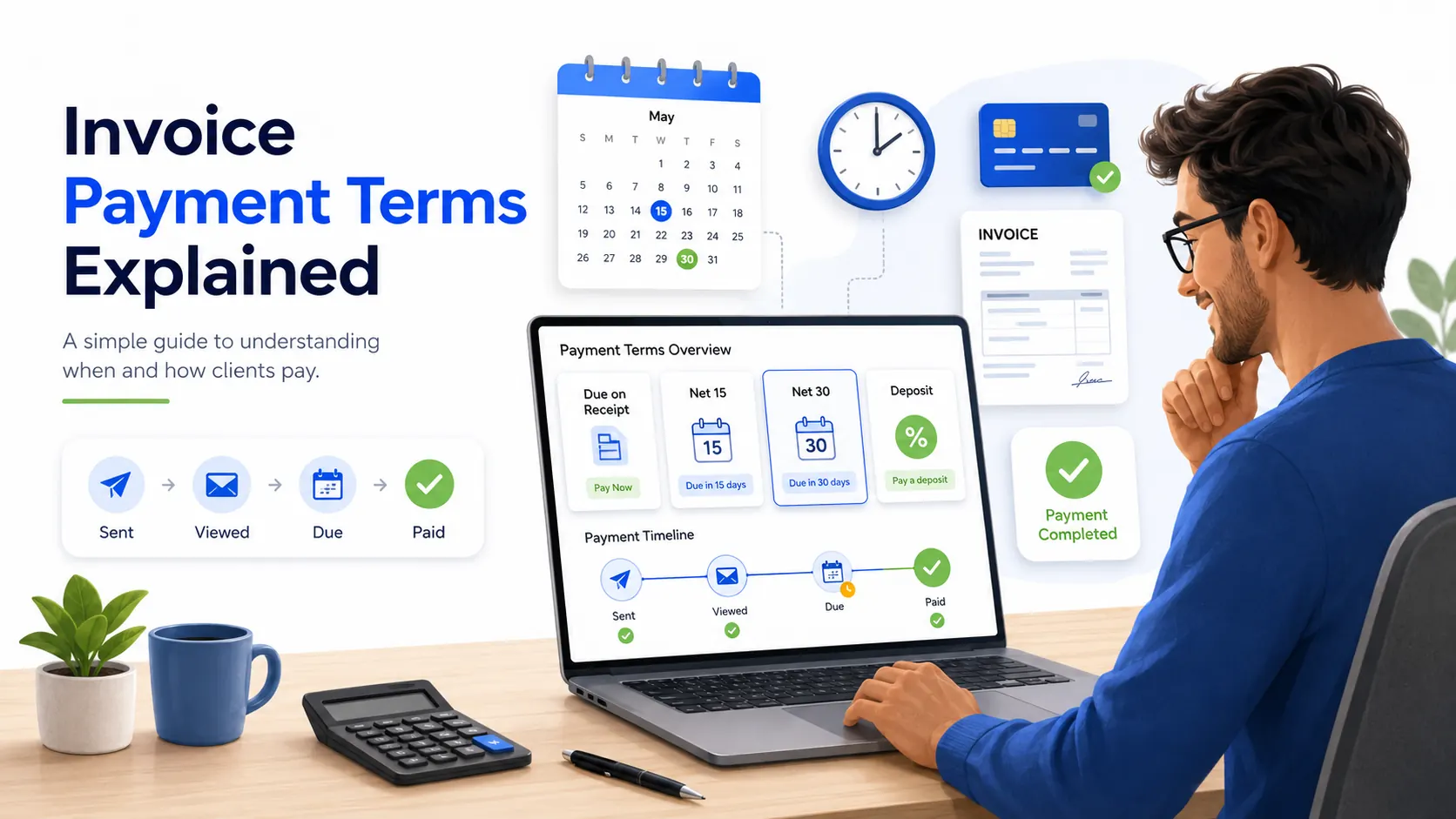
What are invoice payment terms?
Invoice payment terms are the conditions under which you expect to be paid: how long the client has, any discounts for paying early, and any penalty for paying late. They turn a vague "please pay me" into a clear, enforceable expectation, which is exactly what keeps cash flow predictable.
What does Net 30 mean?
Net 30 means the full amount is due 30 days after the invoice date. "Net" refers to the total owed, and the number is the count of days. Net 15 and Net 7 work the same way with shorter windows, while Net 45 and Net 60 give the client longer. Whatever you choose, always print the exact calendar due date so there is no ambiguity. Our invoice due date calculator turns any net term into a date in one click.
Common payment terms at a glance
| Term | What it means | Best for |
|---|---|---|
| Due on receipt | Payment expected immediately | Small or one-off jobs, trusted clients |
| Net 7 | Due 7 days after the invoice date | Fast cash flow, smaller invoices |
| Net 15 | Due 15 days after the invoice date | A common freelancer default |
| Net 30 | Due 30 days after the invoice date | Business clients with AP cycles |
| Net 45 / Net 60 | Due in 45 or 60 days | Large corporations that require it |
| 2/10 Net 30 | 2% off if paid within 10 days, else due in 30 | Nudging clients to pay early |
Early-payment discounts
An early-payment discount rewards a client for paying ahead of the due date. The classic format is "2/10 Net 30": a 2% discount if they pay within 10 days, otherwise the full amount in 30. It costs you a little margin but can dramatically shorten how long you wait, which is often worth it for larger invoices.
Deposits and milestone billing
For larger projects, do not wait until the end to bill. Ask for a deposit of 30-50% upfront and invoice the balance on delivery, or break the work into milestones that each trigger an invoice. This protects your cash flow and filters out clients who never intended to pay.
Late fees
A late fee gives clients a concrete reason to pay on time. A common structure is 1.5% per month (about 18% annually) on the overdue balance, but you must state the policy on the invoice and ideally in your contract before work begins, and you should confirm your state's legal maximum. Use our late fee calculator to work out the charge, and our payment reminder generator to draft a polite nudge.
How to choose the right term
Shorter is almost always better for you. Default to Net 14 or "due on receipt" for small jobs, and reserve Net 30 for larger clients whose process requires it. Whatever you pick, state it clearly on the invoice along with the exact due date and accepted payment methods, so paying you is the easy, obvious next step.
Put these terms on a real invoice
Add net terms, a due date, and payment instructions to a clean, professional invoice in under a minute - free, no signup, no watermark.
Open the invoice generator