What Should I Charge as a Freelancer?
Pricing is the decision that makes or breaks a freelance business, and most people get it wrong by starting too low. The trap is treating your old salary as the benchmark. This guide shows why your freelance rate has to be meaningfully higher than a salaried hourly wage, and walks through a method to find a number that genuinely sustains you.
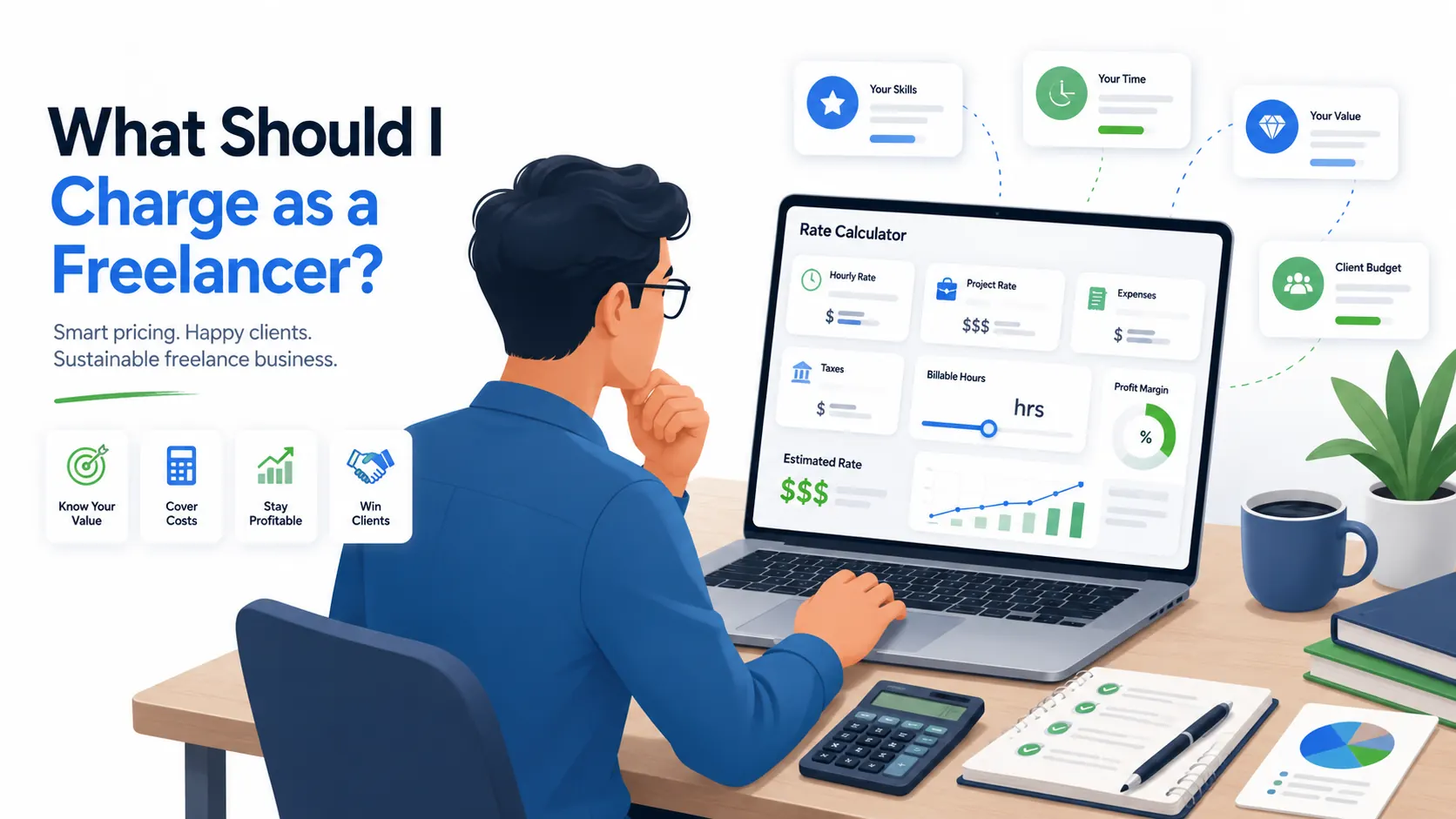
Why your rate must beat your old salaried hourly wage
It is tempting to take your former salary, divide by the standard 2,080 working hours in a year, and call that your rate. If you earned $80,000 that gives about $38 an hour - and it is dangerously wrong. A salaried employee gets a great deal that is invisible from the inside: the employer pays half their payroll taxes, provides health insurance, matches retirement contributions, and pays them during vacations, sick days, and slow weeks. A freelancer charging $38 to "match" that salary would actually end up far poorer.
To earn the same real income as a $80,000 salary, a freelancer often needs to charge $60 to $80 an hour or more. The gap comes from three things you now pay for yourself: non-billable time, self-employment tax and expenses, and benefits.
Billable utilization: you cannot bill every hour
A full-time job is roughly 2,080 hours a year, but you cannot sell all of those to clients. As a freelancer you also spend time on marketing, writing proposals, invoicing, bookkeeping, client calls, learning new skills, and the inevitable gaps between projects. The share of your hours you can actually bill is your utilization rate, and for most solo freelancers it lands between 50% and 70%.
That has a direct impact on your rate. If you want to work 2,000 hours a year but can only bill 60% of them, you have just 1,200 billable hours to hit your entire income target. Every dollar you need for the year has to come from those 1,200 hours, which pushes your hourly rate up substantially.
Building your rate from the ground up
A reliable way to set a floor for your rate is to add up everything the year has to cover and divide by your billable hours:
- The take-home income you want. Start with the salary equivalent you are aiming for.
- Taxes. Add the 15.3% self-employment tax plus federal and state income tax. As a rough planning figure, taxes can claim 25% to 35% of your net profit.
- Business expenses. Software, hardware, insurance, a home office, subscriptions, and professional services all come out of your revenue.
- Benefits you now self-fund. Health insurance premiums, retirement savings, and paid time off that an employer used to cover.
Add those together to get your required annual revenue, then divide by your billable hours. The result is the minimum rate that keeps you whole. Our freelance rate calculator does this math for you, including the utilization adjustment, so you can see how the rate moves as your assumptions change. Once you are working, the time card calculator adds up the hours you bill at that rate.
From cost-plus to value-based pricing
The build-up method gives you a floor, not a ceiling. Charging by the hour is simple and fair on open-ended work, but it has a hidden flaw: it caps your income at the number of hours in a day and actually punishes you for getting faster. The more skilled you become, the less you earn per project on an hourly model.
That is why experienced freelancers shift toward value-based pricing: setting your fee based on the value the work delivers to the client, not the hours it takes you. A landing page that lifts a client's revenue by $50,000 is worth far more than the 15 hours it took you to build. Fixed-project pricing rewards efficiency and expertise, and it gives the client a predictable number. A common path is to bill hourly while you learn how long work really takes, then package that knowledge into fixed prices.
Do not underprice
When you are starting out, the instinct is to compete on price. Resist it. Charging too little starves your business of the money it needs to cover taxes, expenses, and the slow months, and it quietly signals to clients that your work is low value. Raising rates later, especially with existing clients, is harder than setting them correctly from the start. It is almost always better to charge a sustainable rate and win a few good clients than to stay busy and broke.
Once you have a number, quote it cleanly
When you have settled on a rate or a project price, present it professionally. A clear, itemized quote builds trust and reduces back-and-forth - use our quotation generator to turn your number into a polished estimate clients can approve, then our invoice generator to bill it.
Find your real freelance rate
Factor in utilization, taxes, expenses, and benefits to find the hourly rate that actually sustains your business.
Open the freelance rate calculator