How to Fill Out a W-9 as a Freelancer
Nearly every US business client will ask you to complete a Form W-9 before they pay you. It looks official, but it is short and takes a couple of minutes once you know what each line means. This guide walks through it field by field.
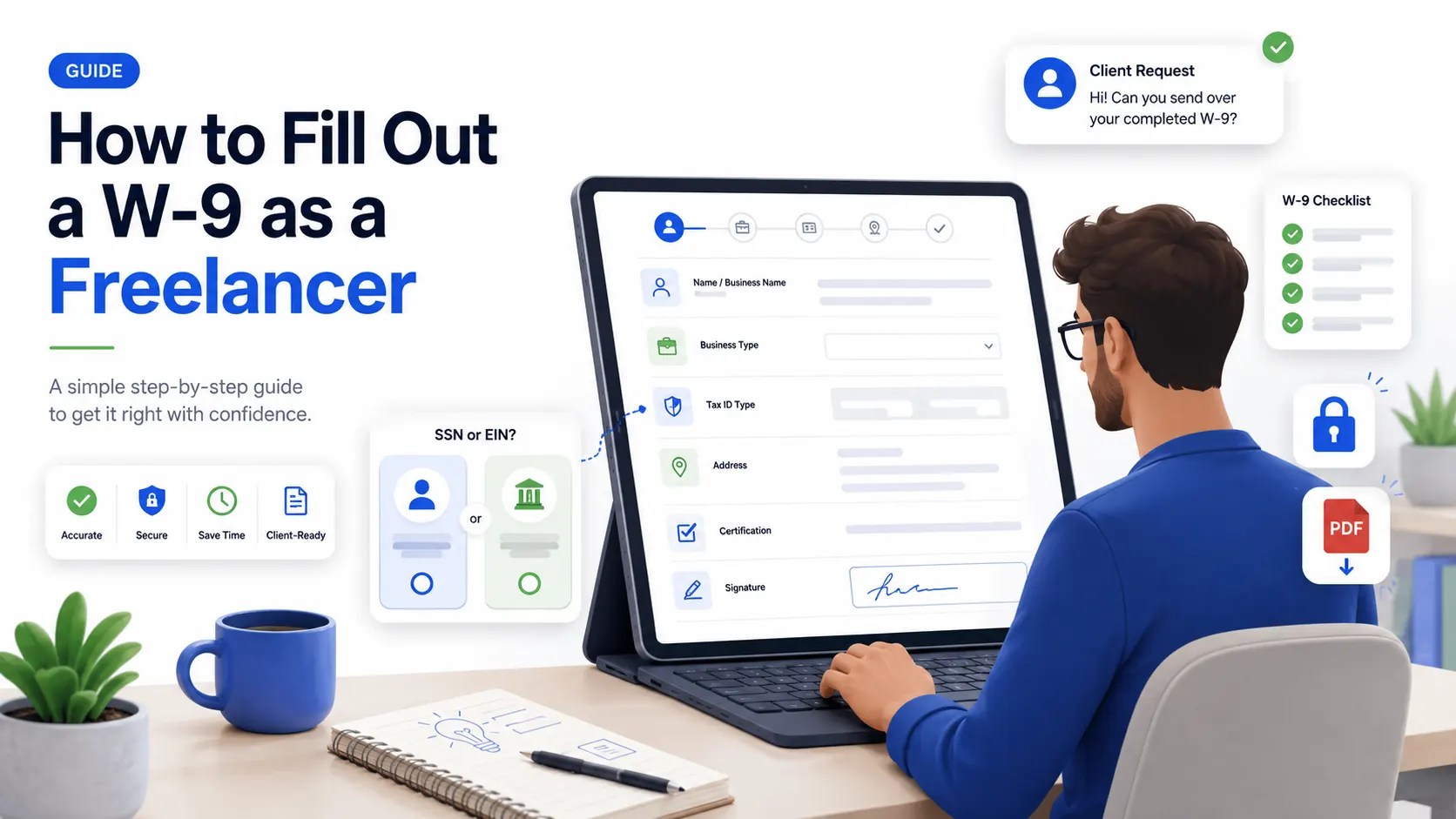
What is a W-9 and why do clients ask for it?
Form W-9 (Request for Taxpayer Identification Number and Certification) is how you give a client your legal name and taxpayer identification number. The client keeps it on file and uses it to report what they pay you to the IRS, typically on a 1099-NEC if they pay you $600 or more in a year. You do not send the W-9 to the IRS yourself, and no tax is withheld from your payments.
W-9 vs W-4 vs 1099
These three forms are easy to confuse. Here is how they relate:
| Form | Who uses it | Purpose |
|---|---|---|
| W-9 | Independent contractors | Give a client your name and taxpayer ID |
| W-4 | Employees | Tell an employer how much tax to withhold |
| 1099-NEC | Issued by the client | Reports what they paid you for the year |
Filling it out, line by line
- Line 1 - Name: your legal name as it appears on your tax return. For a sole proprietor this is your personal name, even if you use a business name.
- Line 2 - Business name: your DBA or business name, if you have one. Leave it blank if not.
- Line 3 - Federal tax classification: check the box that matches you. Most freelancers check "Individual/sole proprietor" or "Limited liability company" (and enter the tax classification for an LLC).
- Line 4 - Exemptions: almost always blank for individual freelancers; it applies to certain entities.
- Lines 5-6 - Address: where the client should mail your 1099.
- Part I - Taxpayer Identification Number: your SSN, or your EIN if you have one. An EIN keeps your SSN off the form.
- Part II - Certification: sign and date to certify the information is correct and that you are not subject to backup withholding.
SSN or EIN: which to use
If you are a sole proprietor you can use either, but an EIN is the safer choice because it keeps your Social Security number off a document you email to clients. You can get an EIN free from the IRS in a few minutes. It does not change how you are taxed; it just gives you a separate business number.
What is backup withholding?
If you do not provide a correct taxpayer ID, or the IRS notifies a client that yours is wrong, the client must withhold a flat percentage of your payments and send it to the IRS. Filling out your W-9 correctly and signing it is what keeps you out of backup withholding, so you receive your full payment.
How to send a W-9 safely
A W-9 contains sensitive information, so do not send it as a plain email attachment if you can avoid it. Use a secure upload link, an encrypted file, or a password-protected document. Only send it to clients you actually work with, and be wary of unsolicited requests.
After the W-9: invoicing and taxes
Once your client has your W-9, you can start invoicing. Use our invoice generator to bill professionally, and our 1099 tax calculator to estimate what to set aside, since no tax is withheld from your payments. If you are weighing contract work against a salaried role, our 1099 vs W-2 guide breaks down the differences.
Ready to invoice your client?
Once your W-9 is in, create a clean, professional invoice in under a minute - free, no signup, no watermark.
Open the invoice generator