EU VAT Invoices & the Reverse Charge
VAT is the part of EU invoicing that trips people up most - which rate to use, and whether to add VAT at all on a cross-border sale. This guide covers what a VAT invoice must show, the standard rates by country, and how the intra-EU reverse charge decides when you charge VAT and when the customer does.
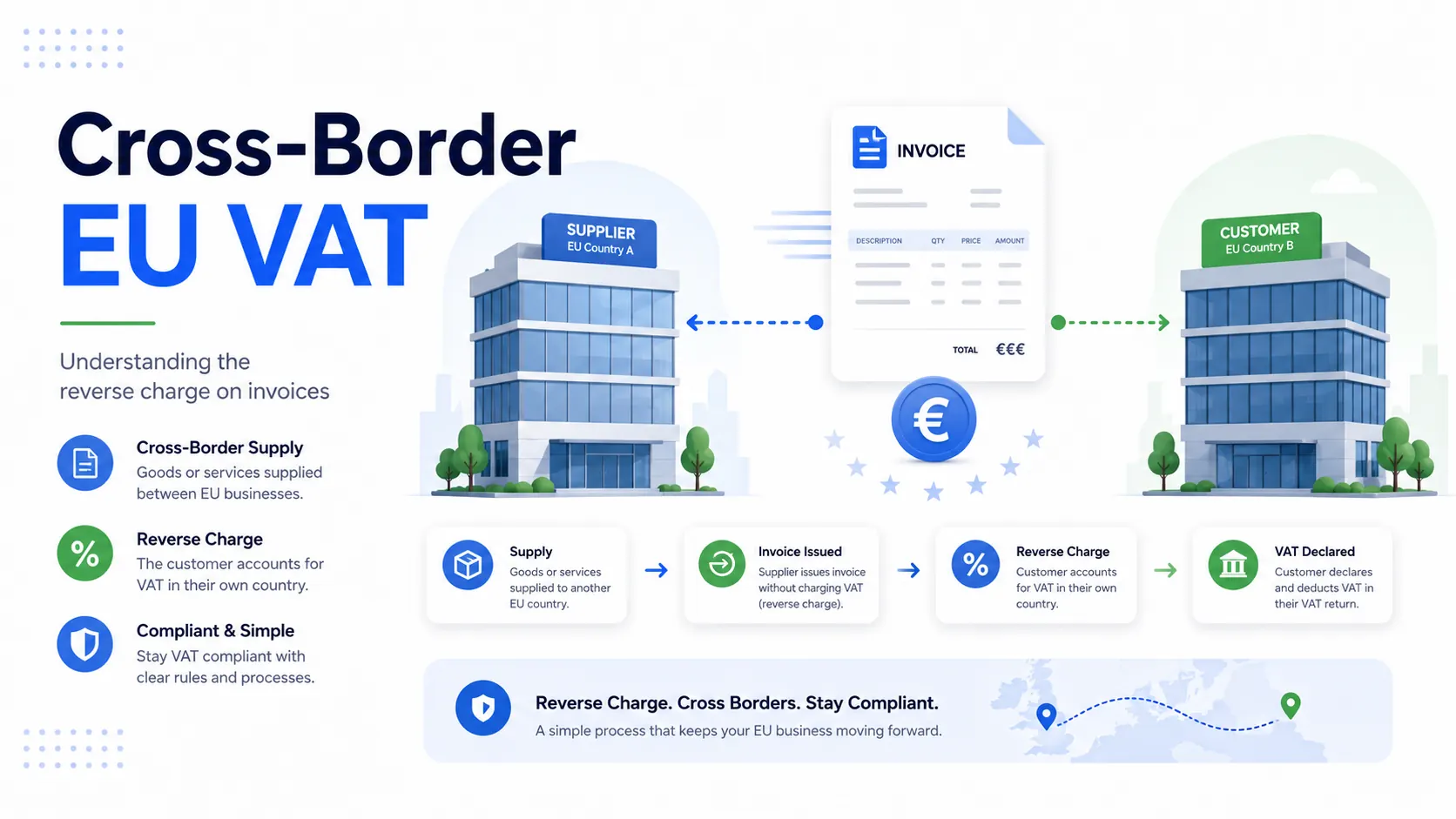
What a VAT invoice must show
A VAT invoice separates the net price, the VAT, and the gross total so a business customer can reclaim the VAT. The core requirements are broadly harmonised across the EU. Whether you build it by hand or use the EU VAT invoice generator, each invoice should include:
- The word "Invoice", a unique sequential number, and the date
- Your business name, address, and VAT number
- The customer's name and address (and VAT number for B2B)
- A description of the goods or services
- The net amount, the VAT rate, and the VAT amount
- The gross total - or a "reverse charge" note where it applies
Standard VAT rates vary by country
Each member state sets its own rates. Standard rates currently range from 17% (Luxembourg) to 27% (Hungary). A few examples:
- Germany 19%, France 20%, Netherlands 21%, Spain 21%, Belgium 21%
- Italy 22%, Ireland 23%, Poland 23%, Portugal 23%
- Sweden 25%, Denmark 25%, Finland 25.5%, Hungary 27%
Most countries also have one or two reduced rates for specific goods and services. To check the arithmetic on a price, the VAT calculator adds or removes VAT at any rate.
The intra-EU reverse charge
Here is the part that confuses people. When you sell B2B to a VAT-registered business in another EU country, you usually do not add VAT. Instead, the reverse charge applies: you note "reverse charge" on the invoice, show both VAT numbers, and the customer accounts for the VAT in their own country at their local rate. It keeps cross-border B2B trade VAT-neutral without you having to register in every country you sell to.
The reverse charge does not apply to everything - it depends on the place-of-supply rules, whether the sale is B2B or B2C, and whether you are selling services or goods. For B2B services the place of supply is usually the customer's country, which is what triggers the reverse charge. This tool helps you format the invoice; it does not decide whether the reverse charge is due for your specific sale.
Distance selling and the One Stop Shop
For cross-border B2C distance sales and certain digital services, the EU has a single EUR 10,000 threshold. Below it, you can charge your home-country VAT; above it, you charge the customer's-country VAT, which you can report through the One Stop Shop (OSS) - a single registration that covers VAT due across the EU, instead of registering in each country.
The bottom line
Get three things right and EU VAT invoicing is manageable: show the required fields, use the correct country's rate when VAT applies, and recognise when the reverse charge means you add no VAT at all. This guide is educational and not tax advice - confirm the treatment for your specific sale, especially across borders.
Create an EU VAT invoice
Build a clean VAT invoice in euros with per-line rates and a reverse-charge note - free, no signup, no watermark.
Open the VAT invoice generator