The 2026 Tax Changes Every Freelancer Should Know
The One Big Beautiful Bill Act (OBBBA), signed in July 2025, reshaped several rules that hit self-employed people directly in the 2026 tax year. Most coverage focused on big-picture politics; this guide translates the parts that actually change what a freelancer owes and reports - the new 1099 threshold, a permanent QBI deduction, a larger standard deduction, and a couple of things that are easy to get wrong.
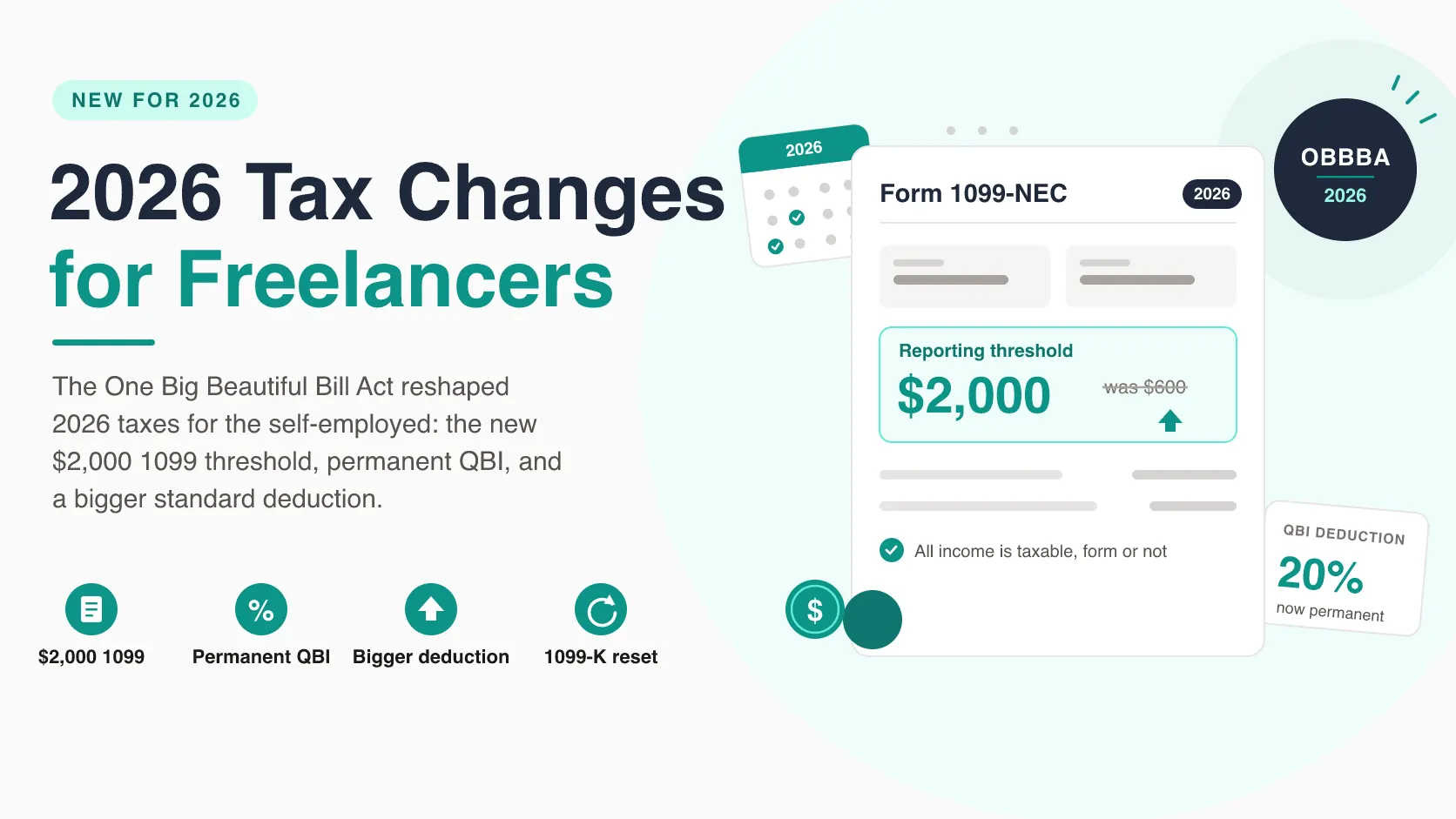
The 1099 reporting threshold jumped to $2,000
For years, a client had to issue a Form 1099-NEC once they paid you $600 or more in a year. Starting with payments made in 2026, that threshold rose to $2,000 (and it will be indexed for inflation afterward).
Here is the part that trips people up: the threshold only decides whether a client has to send the form. It does not change what is taxable. If a client pays you $1,500 in 2026 and sends nothing, that $1,500 is still self-employment income you must report. The practical takeaway is the same as it has always been - track your own income from invoices and payment records rather than waiting for forms to arrive in January.
The QBI deduction is now permanent
The Qualified Business Income (QBI) deduction lets many self-employed people deduct up to 20% of their net business income before income tax - one of the most valuable breaks a freelancer has. It was scheduled to expire after 2025; OBBBA made it permanent.
For 2026, the income level where it begins to phase out for "specified service" businesses - consulting, design, law, health, and finance - is $201,775 (single) or $403,500 (married filing jointly), and the phase-in range was widened, so the deduction fades more gradually above those thresholds. Below them, most freelancers still get the full 20%. Our freelancer tax deductions guide covers how QBI fits with your other write-offs.
A bigger standard deduction
OBBBA raised the standard deduction, and it continues to rise with inflation. For 2026 it is $16,100 for single filers, $32,200 for married filing jointly, and $24,150 for head of household. Because most freelancers take the standard deduction rather than itemizing, this directly lowers the income your federal tax is calculated on - and, combined with permanent QBI, it can shave a few points off the percentage you need to set aside.
"No tax on tips" and "no tax on overtime" - who they actually help
Two headline provisions run from 2025 through 2028: an above-the-line deduction for qualified tips (up to $25,000) and for qualified overtime pay (up to $12,500 single / $25,000 joint). Both phase out at higher incomes and apply only to certain occupations and to reported tip or overtime income - largely a W-2 employee benefit.
If you freelance full-time, these usually won't apply to your contract income. But if you also work a tipped or hourly job on the side, they can lower your combined bill. Check the IRS guidance for the qualifying-occupation list before counting on either.
The 1099-K threshold went back up
If you sell through online marketplaces or get paid through payment apps, you may receive a Form 1099-K. OBBBA restored the older reporting threshold - more than $20,000 and 200 transactions - undoing the $600 threshold that had been phasing in. As with the 1099-NEC, this only affects whether a form is issued; platform income is taxable whether or not you receive a 1099-K.
What to do about it
- Keep your own income records. Do not rely on 1099s to tell you what you earned - the higher thresholds mean fewer forms, not less taxable income.
- Recheck your set-aside percentage for 2026. A bigger standard deduction and permanent QBI can lower it; a high income or state tax can raise it. Our how much to set aside guide walks through the math.
- Re-run your numbers with the 1099 tax calculator, then confirm your quarterly payments against the 2026-2027 tax deadlines.
Last reviewed July 12, 2026. This is an educational summary, not tax advice; OBBBA provisions have detailed rules and phase-outs. Verify specifics with the IRS or a qualified professional. Sources: IRS (1099-NEC instructions, QBI deduction) and the Tax Foundation's OBBBA and 2026 tax-bracket analyses. See our methodology.
Re-run your 2026 numbers
See what to set aside under the 2026 rules - permanent QBI, a bigger standard deduction, and your state tax - in seconds.
Open the 1099 tax calculator